Búsqueda avanzada
Buscar
 

Entra en BiblioEteca...

Disfruta de todo el potencial de biblioEteca entrando con tu usuario...


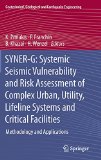
SYNER-G: SYSTEMIC SEISMIC VULNERABILITY AND RISK ASSESSMENT OF COMPLEX URBAN, UTILITY, LIFELINE SYSTEMS AND CRITICAL FACILITIES


AUTOR: ; ND
 
 
  • Portada de SYNER-G: SYSTEMIC SEISMIC VULNERABILITY AND RISK ASSESSMENT OF COMPLEX URBAN, UTILITY, LIFELINE SYSTEMS AND CRITICAL FACILITIES

    9789401788342

 
Compartir: Compartir con un amigo de biblioeteca Compartir por email Compartir en Facebook Compartir en X Capturar código QR Añadir RSS

Sinópsis del libro:

  • SYNER-G allowed the development of an innovative methodological framework for the assessment of physical as well as socio-economic seismic vulnerability and risk at urban and regional level. It paved new ground in the seismic risk assessment of complex interacting systems by proposing methods and simulation software tools to consider inter-element and intra-systems interdependencies, including socio-economic features, in a comprehensive probabilistic framework. The results of this multidisciplinary effort funded by the European Union are presented in two books both published in Springer, the present and a second one, entitled ?SYNER-G: Typology Definition and Fragility Functions for Physical Elements at Seismic Risk: Buildings, Lifelines, Transportation Networks and Critical Facilities?(*), which provides a comprehensive state-of-the-art of the fragility curves, an alternative way to express physical vulnerability of elements at risk.

    In this second volume of SYNER-G, the focus has been on presenting a unified holistic methodology for assessing vulnerability at systems level considering interdependencies between elements at risk (physical and non-physical) belonging to different systems and between different systems. The proposed methodology and tool encompasses in an integrated fashion all aspects in the chain, from hazard to the vulnerability assessment of components and systems and to the socio-economic impacts of an earthquake, accounting for most relevant uncertainties within an efficient quantitative simulation scheme, and modelling interactions between the multiple component systems. It systematically integrates the most advanced fragility or vulnerability functions to assess the vulnerability of physical assets for the following systems: buildings and building aggregates; utility systems including water, waste water, gas, oil and electric power networks; transportation networks including roadways, railways and harbour systems and critical facilities such as hospitals. The increasing impact due to interdependencies and intra-dependencies between different components and among different interacting systems is treated in a comprehensive way, providing specifications for each network and infrastructure. The proposed socio-economic model integrates social vulnerability into the physical systems modelling approaches providing to decision makers with a dynamic platform to capture post disaster emergency issues like shelter demand and health impact decisions.

    Application examples at city and regional scale provided the necessary validation of the methodology. The present volume, with its companion one on the fragility functions, represent a significant step forward in the seismic vulnerability and risk assessment of complex interacting urban and regional systems, aggregates and networks. They are addressing not only to scientists and engineers but also to the insurance industry, decision makers and practitioners in the sector of civil protection and seismic risk management.

    (*) Pitilakis K, Crowley E, Kaynia A (eds) (2014) SYNER-G: Typology definition and fragility functions for physical elements at seismic risk, Series: Geotechnical, Geological and Earthquake Engineering 27, ISBN 978-94-007-7872-6, Springer Science+Business Media, Dordrecht.

    Idioma: INGLÉS


Clasificador

Según nuestros usuarios

RIGUROSO
Riguroso

Determina lo preciso o impreciso que es este libro con respecto a lo que se cuenta en el mismo. 0 significa que es completamente impreciso y 10 que cuenta es rigurosamente verídico

Más información
DIVERTIDO
Divertido

Determina lo divertido que te ha resultado el libro: 0-aburrido 10-muy divertido

Más información
COMPLEJO
Complejo

Determinamos lo complejo que nos ha resultado la lectura del libro. Desde el nivel más bajo, que indica que es un texto secillo de comprender hasta el valor máximo que indica que es complejo de comprender

Más información
SORPRENDE
Sorprende

Indica lo sorprendente que resulta el argumento del libro, desde 0: previsible hasta 10: totalmente desconcertante y sorprendente

Más información


Etiquetas de otros usuarios

Así han etiquetado este libro más usuarios

Así han etiquetado otros usuarios este libro. Si ves acertada su elección puedes añadir la etiqueta con un simple clic a tus etiquetas

 
Publicidad Baliza v16 Baliza v16


Comentarios de los lectores


Yo Leo

Información para lectores

Anillo de blogs

¿Tienes un blog?

Paga si te gusta

La forma de pago del futuro...

BiblioEtecarios

Ayudanos con los libros

Yo Escribo

Si eres autor, descubre más...

Ayuda

Todo lo que puedes hacer en la web
C/ Mayor, 50, 2C.
28921 Alcorcón (Madrid)
Tel/Fax : 91 288 73 76
E-mail : info@biblioeteca.com

BiblioEteca en Rss

 
Copyright © 2026 BiblioEteca Technologies SL - Todos los derechos reservados