Búsqueda avanzada
Buscar
 

Entra en BiblioEteca...

Disfruta de todo el potencial de biblioEteca entrando con tu usuario...


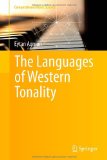
THE LANGUAGES OF WESTERN TONALITY


AUTOR: ; ND
 
 
  • Portada de THE LANGUAGES OF WESTERN TONALITY

    9783642395864

 
Compartir: Compartir con un amigo de biblioeteca Compartir por email Compartir en Facebook Compartir Twitter Compartir en Tuenti Capturar código QR Añadir RSS

Sinópsis del libro:

  • Tonal music, from a historical perspective, is far from homogenous; yet an enduring feature is a background "diatonic" system of exactly seven notes orderable cyclically by fifth. What is the source of the durability of the diatonic system, the octave of which is representable in terms of two particular integers, namely 12 and 7? And how is this durability consistent with the equally remarkable variety of musical styles ? or languages ? that the history of Western tonal music has taught us exist? This book is an attempt to answer these questions. Using mathematical tools to describe and explain the Western musical system as a highly sophisticated communication system, this theoretical, historical, and cognitive study is unprecedented in scope and depth. The author engages in intense dialogue with 1000 years of music-theoretical thinking, offering answers to some of the most enduring questions concerning Western tonality. The book is divided into two main parts, both governed by the communicative premise. Part I studies proto-tonality, the background system of notes prior to the selection of a privileged note known as "final." After some preliminaries that concern consonance and chromaticism, Part II begins with the notion "mode." A mode is "dyadic" or "triadic," depending on its "nucleus." Further, a "key" is a special type of "semi-key" which is a special type of mode. Different combinations of these categories account for tonal variety. Ninth-century music, for example, is a tonal language of dyadic modes, while seventeenth-century music is a language of triadic semi-keys. While portions of the book are characterized by abstraction and formal rigor, more suitable for expert readers, it will also be of value to anyone intrigued by the tonal phenomenon at large, including music theorists, musicologists, and music-cognition researchers. The content is supported by a general index, a list of definitions, a list of notation used, and two appendices providing the basic mathematical background.

    Idioma: INGLÉS


Clasificador

Según nuestros usuarios

RIGUROSO
Riguroso

Determina lo preciso o impreciso que es este libro con respecto a lo que se cuenta en el mismo. 0 significa que es completamente impreciso y 10 que cuenta es rigurosamente verídico

Más información
DIVERTIDO
Divertido

Determina lo divertido que te ha resultado el libro: 0-aburrido 10-muy divertido

Más información
COMPLEJO
Complejo

Determinamos lo complejo que nos ha resultado la lectura del libro. Desde el nivel más bajo, que indica que es un texto secillo de comprender hasta el valor máximo que indica que es complejo de comprender

Más información
SORPRENDE
Sorprende

Indica lo sorprendente que resulta el argumento del libro, desde 0: previsible hasta 10: totalmente desconcertante y sorprendente

Más información


Etiquetas de otros usuarios

Así han etiquetado este libro más usuarios

Así han etiquetado otros usuarios este libro. Si ves acertada su elección puedes añadir la etiqueta con un simple clic a tus etiquetas

 
Publicidad La Asistenta La asistenta


Comentarios de los lectores


Yo Leo

Información para lectores

Anillo de blogs

¿Tienes un blog?

Paga si te gusta

La forma de pago del futuro...

BiblioEtecarios

Ayudanos con los libros

Yo Escribo

Si eres autor, descubre más...

Ayuda

Todo lo que puedes hacer en la web
C/ Parque Bujaruelo, 37, 1C.
28924 Alcorcón (Madrid)
Tel/Fax : 91 288 73 76
E-mail : info@biblioeteca.com

BiblioEteca en Google Plus BiblioEteca en Rss

 
Copyright © 2021 BiblioEteca Technologies SL - Todos los derechos reservados